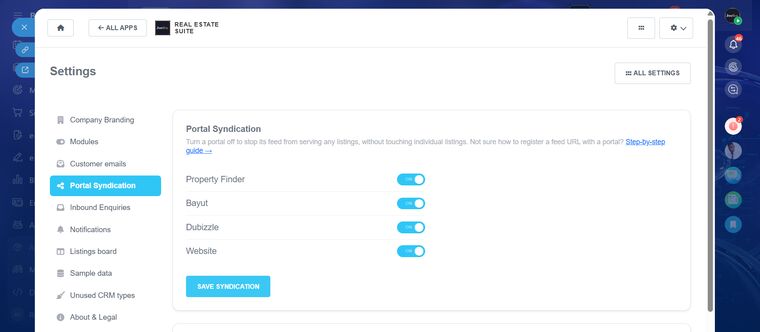
Every Dubai agency ends up asking the same question: why are we typing the same listing into Property Finder, Bayut, Dubizzle and our own website, four times, every time a price changes?
You should not be. All three portals accept an automated feed. Most agencies simply have not been shown how it works — so here it is, without the sales pitch.
What a feed actually is
A portal feed is a single web address on your system that returns your listings in a structured XML format. You give that address to the portal once. From then on the portal visits it on a schedule — typically every few hours — reads whatever is there, and updates its site to match.
That is the whole mechanism. There is no live API connection to maintain, no plugin to keep updated. Publish a listing in your system, and it appears at the next fetch. Change the price, and the price changes. Archive it, and it drops off.
The part most people get wrong
The advertiser account stays yours. You register the feed URL inside your own Property Finder or Bayut account. Your software vendor supplies the address; the portal relationship, the contract and the credits remain in your name.
Be careful here. If a vendor wants to publish listings through their portal account, walk away. Your listings, your leads and your portal history should never sit inside somebody else's advertiser account — if you part ways, you lose all of it.
What each portal wants
The three portals accept similar information in different shapes:
- Property Finder requires its own location taxonomy. "Dubai Marina" is not free text — it maps to a specific location id, and a listing with an unrecognised location is rejected.
- Bayut keeps a separate location tree with different ids for the same places, plus its own permit-number handling.
- Dubizzle shares much of Bayut's structure but differs on categories.
This is why "just export a CSV" does not work. Any system serious about syndication carries the portals' location taxonomies internally and maps your listing to the right id per portal. If a vendor cannot explain how they handle location mapping, they have not built this properly.
Trakheesi and permit numbers
Dubai requires a valid permit number on advertised listings, and the portals enforce it. Your listing system needs a field for it, and ideally should refuse to publish without one. That single validation prevents most rejected-listing headaches.
Where the enquiries go
Syndication is only half the value. The other half is what happens when someone enquires.
Done properly, a portal enquiry arrives in your CRM as a lead, already attached to the listing it came from, already assigned to that listing's agent. Done badly, it lands in a shared inbox and somebody forwards it on WhatsApp.
The measurable difference is response time, and response time is what converts. An enquiry answered in ten minutes converts several times better than the same enquiry answered tomorrow — the portals themselves publish data on this.
A checklist before you buy anything
- Does the feed URL register against my advertiser account?
- Can I switch a portal off for one listing without unpublishing it everywhere?
- How are Property Finder and Bayut locations mapped, and who maintains that mapping?
- Is the permit number validated before publishing?
- Do enquiries arrive as CRM leads attached to the listing and its agent?
- Can I rotate the feed URL if it leaks?
- What happens to my listings if I stop paying?
Any competent vendor can answer all seven in a single call. See how our Real Estate Suite handles syndication, or ask us to review your current setup — we will tell you honestly whether it needs replacing.